
How does working memory prepares cognition for what comes next?
I work on how working memory, attention and prior knowledge interact together and potentially shape behavior. My research can be described in three main topics. Neural dynamics underlying:
- how prior information shape the way we encode and maintain information
- how the cognitive system protects itself from predicted or unpredicted competing information
- how memorized information is transformed to simulate future states
1. Prediction and prior knowledge
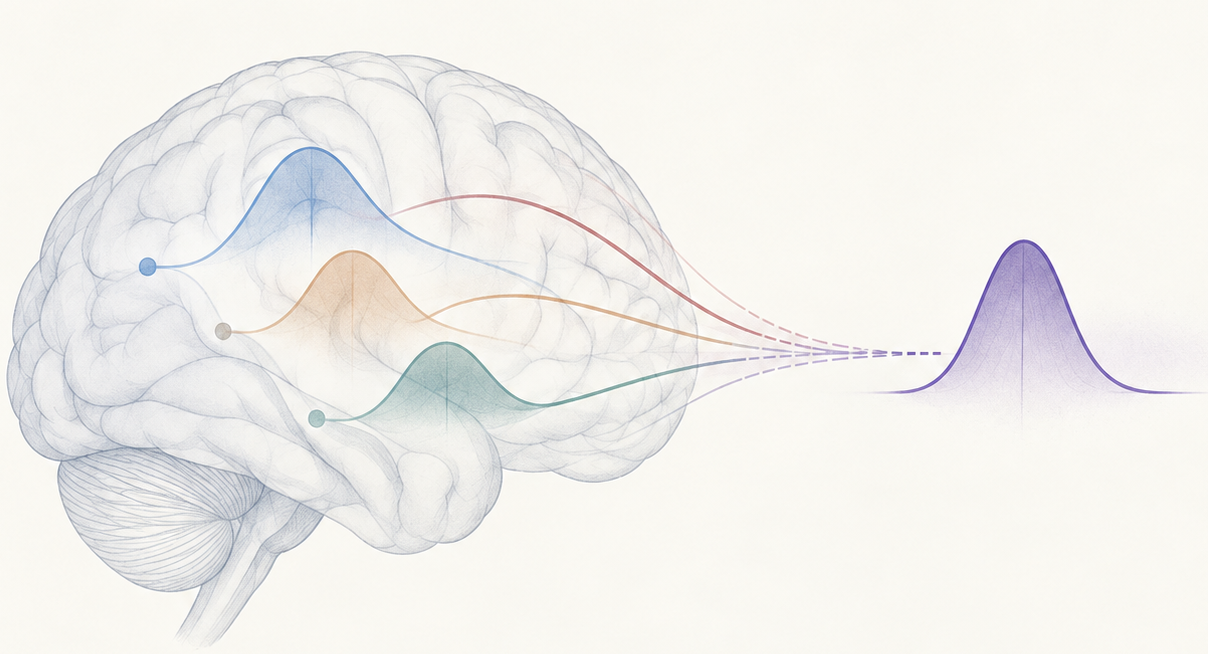
Our experience is structured by regularities. In everyday life, we rarely encounter information without expectations about what might come next. More precisely, you might have expectations about how it might feel to hold your coffee cup or where the rearview mirror might be situated in a car. Or, more diffusely, you might expect that a tennis serve will land somewhere in the service box.
I study how this diffuse prior knowledge and these predictions influence working memory representations and interact with spatial attention.
Using multivariate EEG analyses, we found that even when predictions specify only a range of possible upcoming stimuli—orientation gratings—they systematically reshape neural representations during working memory encoding but not during maintenance.
Predictable items were represented with less neural variance, within a compressed representational space and biased toward the expected range, suggesting that expectations can alter the geometry and stability of neural codes rather than simply enhancing their strength.
We are currently investigating how implicitly learned statistical regularities interact with attentional selection, asking when learned expectations facilitate—and potentially bias—the processing of incoming information.
Related publications:
Ataseven, N., Özdemir, Ș., Kruijne, W., Schneider, D., & Akyürek, E. G. (2026, preprint). Diffuse predictions stabilize and reshape the neural code during working memory encoding. bioRxiv.
https://doi.org/10.64898/2026.02.23.707359
Ongoing projects:
Ataseven, N., Brady, T. F., Kruijne, W., & Akyürek, E. G. Bidirectional relationship between statistical regularity learning and attention.
2. Mental transformation (and internal simulation)
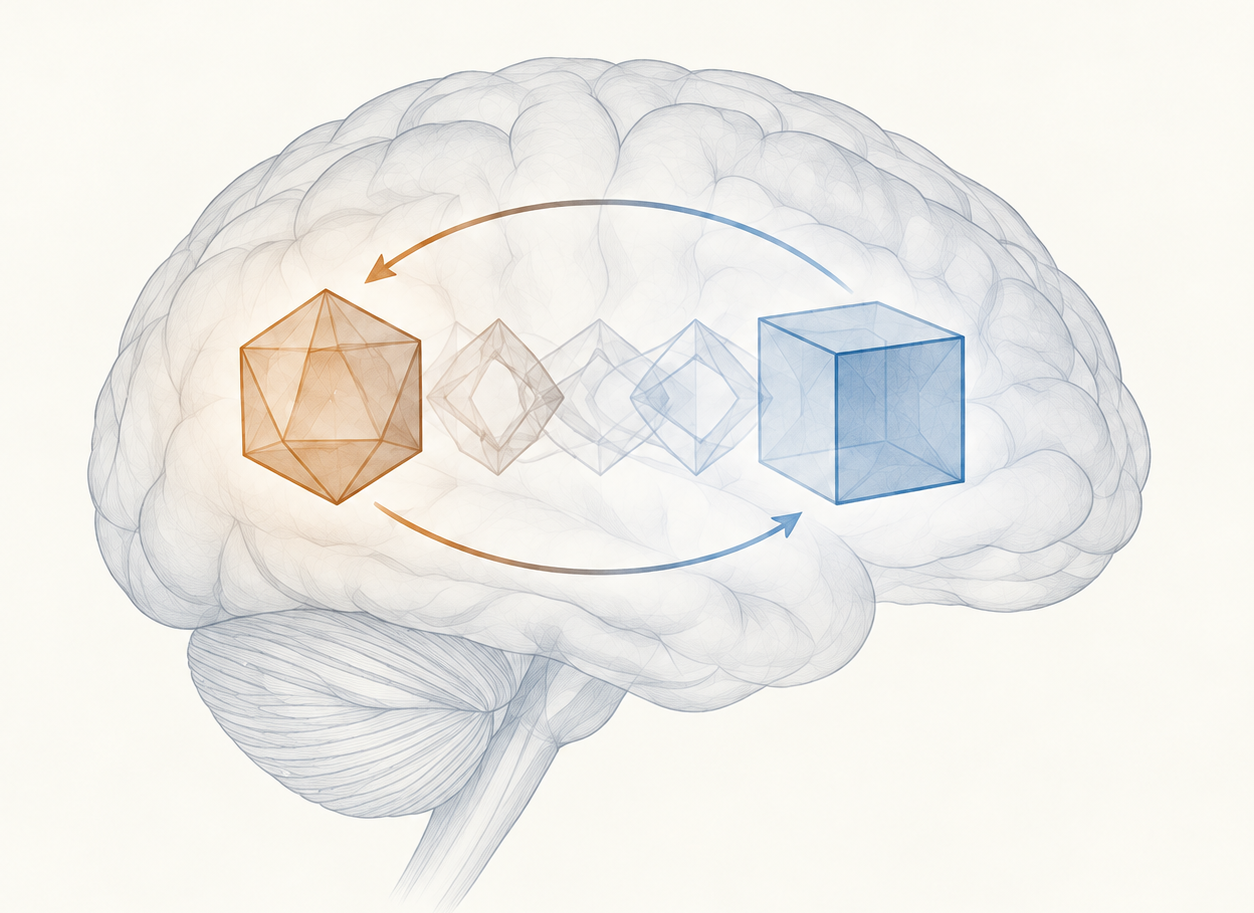
Working memory allows us not only to maintain information, but also to manipulate it. When you see a car in the traffic, you may compute its future location based on some parameters like its current location, speed and direction. My research examines the neural representation that underly these transformations. Using EEG decoding, we found that after an initially memorized original orientation was mentally rotated, the original remained available alongside the transformed representation. Importantly, the fate of the two representations was linked: when attention selected the transformation product, its original source representation was retained with it. These findings suggest that mental transformation can create a dependent representational structure, in which a newly constructed state remains linked to the information from which it was derived Furthermore, I am interested in how working memory may support prediction by providing a workspace in which possible future states can be mentally simulated through such transformations.
Related publications:
Ataseven, N., Özdemir, Ș., Kruijne, W., Schneider, D., & Akyürek, E. G. (2026, preprint). Mentally transformed representations in memory are linked to their originals. https://doi.org/10.64898/2026.09.10.750562
3. Interference, attention & memory control
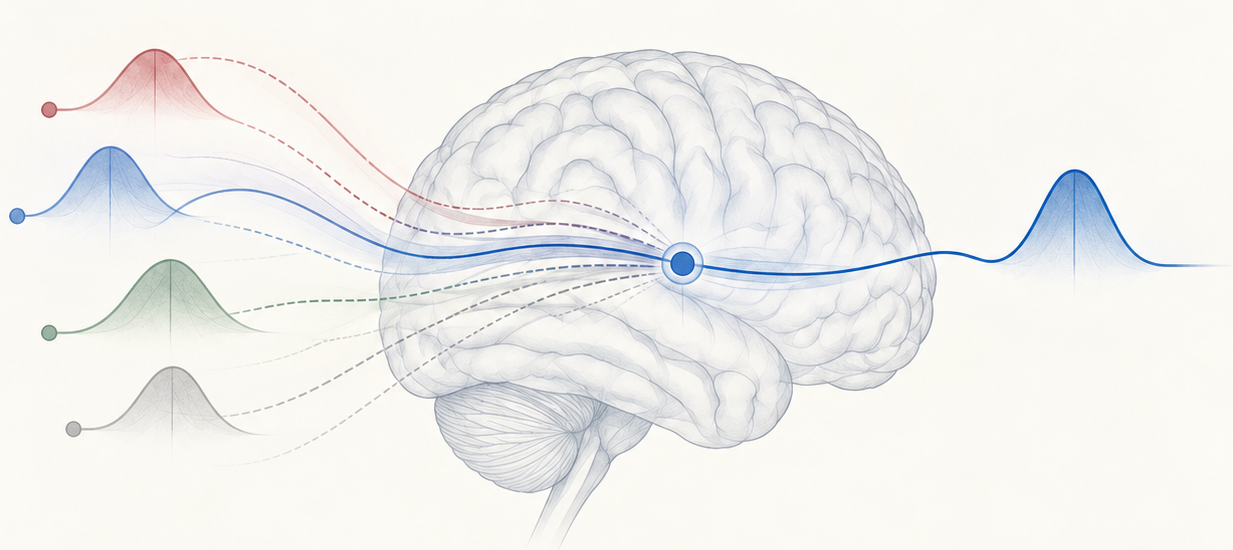
Memory rarely operates in isolation. While maintaining or retrieving information, we often have to divide attention, perform another task, ignore distraction, or prepare for upcoming interference or additional information. A third line of my research investigates how attention and anticipated task demands regulate the interaction between working memory and long-term memory. I am interested in when information available in long-term memory is maintained or reactivated in working memory, when cognition can instead rely more directly on long-term memory, and how these two strategies are influenced by competing demands on attention. In summary, this line of work asks how cognition flexibly allocates limited resources across memory, attention, and anticipated task demands.
Related publications:
Ataseven, N., Algın, E., Yücel, D., Güler, B., Todorova, L., Fukuda, K., & Günseli, E. (2026). Memory reactivation levels remain unaffected by anticipated interference. Journal of Cognitive Neuroscience, 1–12. https://doi.org/10.1162/jocn.a.2625
Yılmaz, Y., Ataseven, N., Kruijne, W., Akyürek, E., & Günseli, E. (2026). Passive but accessible: Studied information is not actively stored in working memory, yet attended regardless of anticipated load. Journal of Cognitive Neuroscience, 38(9), 1721–1734. https://doi.org/10.1162/jocn.a.2619
Ataseven, N., Ünver, N., & Günseli, E. (2023). How does divided attention hinder different stages of episodic memory retrieval?. Current Research in Behavioral Sciences, 100139. https://doi.org/10.1016/j.crbeha.2023.100139
Yucel, D., Ataseven, N., Todorova, L., Güler, B., Fukuda, K., & Gunseli, E. (2023, preprint). Increased reliance on long-term memory when anticipating attentional guidance. PsyArXiv. https://doi.org/10.31234/osf.io/cs9qa